The Disability History Association (DHA) promotes the relevance of disability history and facilitates research, publication, conference travel, and public history initiatives related to disability history. Inspired by this mission, the Disability History Association annually confers two publication awards: the Outstanding Book Award and the Outstanding Article/Book Chapter Award.
Outstanding Book Award
The Disability History Association (DHA) promotes the relevance of disability history and facilitates research, publication, conference travel, and public history initiatives related to disability history.
As part of the Disability History Association’s 2026 Award Series, the DHA Award Committee invites entries for its fifteenth annual Outstanding Book Award. The amount of the award is $300. The winning book, as well as the book receiving the honorable mention, will be announced in September 2026.
Eligibility: Committee members welcome monographs and edited collections, provided the book is new, original scholarship and published in English. The award is open to authors writing across all geographic areas and time periods whose book was first published between January 1 and December 31, 2025. Members of the DHA Board of Directors are not eligible to apply.
Details for the 2027 award will be available in spring 2027.
Past Award Winners
2026 Outstanding Book Award
Winner

iana Martha Louis, Colored Insane: Slavery, Asylums, and Mental Illness in the Nineteenth Century (New York: Columbia University Press, 2025).
Colored Insane is a powerful example of the fruitful interplay between the history of disability and the history of race. Louis offers a particularly strong combination of methodological innovation and historical significance. Reading Black-authored medical and intellectual writing, slave narratives, fiction, asylum records, and psychiatric texts together, she shows how nineteenth-century psychiatry racialized mental disability while slavery, confinement, and social violence inflicted real psychological harm. Most compelling is her recovery of a Black counter-discourse. Her interdisciplinary integration of literary and historical analysis, disability studies, and Black feminist theory strengthens this original and accessible contribution to disability history.
2025 Outstanding Book Award
Winner
Dagmar Herzog, The Question of Unworthy Life: Eugenics and Germany’s Twentieth Century (Princeton: Princeton University Press, 2024).

The Question of Unworthy Life is a vital addition to studies of the Nazi Aktion T4 project to exterminate disabled people in Germany and its Reich. What makes it so impressive is the longue durée that it draws together, showing the context in which the attitudes behind these crimes were formed from the nineteenth century onwards and then the myriad legacies and battles, post-WWII, to reckon with them and the ongoing fact of disability within German society. Particularly striking and important is the book’s emphasis at all points on those who acted against the status quo, in word or deed. This is a powerful counterpoint to any impression of inevitability and a reminder of the significance of individual agency even amidst the most oppressive social structures.
Honorable Mention
Regina Kunzel, In the Shadow of Diagnosis: Psychiatric Power and Queer Life (Chicago: University of Chicago Press, 2024).

Sensitively and beautifully written, In the Shadow of Diagnosis provides an unflinching look at how clinicians and researchers in the twentieth century United States saw homosexuality as a “problem” that only psychiatry could solve, and who believed that doing so might be the key to bolstering psychiatry as a profession. But Kunzel also provides deep analysis of those who sought out, received, and provided such psychiatric treatment, elegantly balancing her engagement with a remarkable new archive of patient files with interviews, published works, and memoir to produce a compelling human portrait of those on either side of the coin. This powerful book offers thought-provoking reflections on the weight and value of claims about illness, wellness, normalcy, and disorder in our recent past.
2024 Outstanding Book Award
Winner
 Janet Weston, Looking after Miss Alexander: Care, Mental Capacity, and the Court of Protection in Mid-Twentieth Century England (McGill-Queen’s University Press, 2023).
Looking after Miss Alexander is an unusual and interesting book, beautifully written. With rigorous archival work – that includes interesting reflections on the archive, the role of the historian, and the place of historical imagination in history writing and research – this microhistory explores key issues within disability studies such as care, independence, illness, capacity, citizenship and vulnerability, raising important questions on how mental health was assessed in mid-20th century Britain. A sensitive portrayal of the experience of Miss Alexander, this rigorous study of mental/intellectual disability sets a new standard for how historians talk and write about disability.
Honorable Mention 
Selina Mills, Life Unseen: A Story of Blindness (Bloomsbury Publishing, 2023)
Life Unseen brings home to non-academic audiences all the important themes of disability history. It is well-written and captivating, a great work of synthesis that both raises important questions on how blind people have been represented in Western culture and deconstructs many myths about blindness. A moving, personal account that also traces the social construction of blindness across a range of geographical and chronological examples, it threads life experience through a broad history.
2023 Outstanding Book Award
Winner
Wei Yu Wayne Tan, Blind in Early Modern Japan: Disability, Medicine, and Identity (University of Michigan Press, 2022).
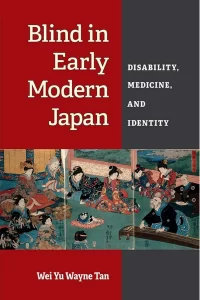
The award committee described Blind in Early Modern Japan as a “carefully constructed work [that] fills in vital historical gaps: early modern era, Japan, and blind history.” It is “an impressive piece of scholarship” that “reveals new understandings of the relationships between medicine/systems of medicine and being blind, as well as how (a non-Western) religion contributed to the meaning and experience of being blind.” Tan “has done a superb job of locating and interpreting from a disability history perspective the experiences of blind people,” showing “how blind people formed an identifiable group of professionals from musicians, acupuncturists, and scholars, among other occupations, with elite males forming their own guild.” The author “paid thoughtful attention to gender and gender hierarchies, demonstrated significant research skills (including multilingual translation and interpretation), and worked diligently to center disabled people as active agents in this account. Through innovative approaches to historical sources and interpretations, Tan traces a different medical system—Sino-Japanese—than the Western biomedical model that dominates most disability history works. In so doing, he reveals new understandings of the relationships between medicine/systems of medicine and being blind, as well as how (a non-Western) religion contributed to the meaning and experience of being blind.”
Honorable Mention
Alexandre Sumpf, The Broken Years: Russia’s Disabled War Veterans, 1904-1921 (Cambridge University Press, 2022)
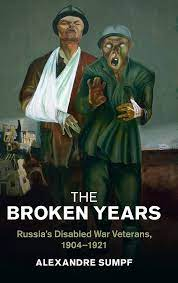 According to the selection committee’s comments, The Broken Years is “a superbly researched study of disabled veterans in Russia that addresses a significant omission in the historical record and insists on the important role disabled veterans have played in Russia’s past.” Characterized by “extensive, wide-ranging, and multilingual archival work,” the book importantly draws upon “first-person accounts from disabled soldiers’ points of view.” Sumpf is “expansive yet meticulous in his argument,” challenging readers “to consider wars as interlocking rather than discrete and individual: this is particularly useful for disability historians across many regions and eras.”
2022 Outstanding Book Award
Winner

Susan Burch, Committed: Remembering Native Kinship in and Beyond Institutions (University of North Carolina Press, 2021)
The committee described the work as “a beautifully written and constructed book…that transforms the way that scholars think about and do “institutional histories.” It is “a powerful book that makes a huge contribution to the field” and “sheds light on the entanglement of settler colonialism, racism, ableism and sexism.” “The author does not write a top-down history but rather provides a microhistorical approach, focusing on the lived stories.” Committed is an “innovative and an important contribution to the field as Native American history has scarcely been explored through the lens of disability.” “More than traditional ‘history,’ it is a remembering, a reinvigoration of cultural memory nearly lost due to inaccessible institutional archives and direct oral traditions.”
Honorable Mention
Sandra M. Sufian, Familial Fitness: Disability, Adoption, and Family in Modern America (University of Chicago Press, 2021)
The committee shared the following assessment: “Sufian’s study…represents intersectional history at its best by unpacking numerous entanglements such as race, eugenics, and epidemics…The narrative is persuasive in showing how dominant views on normality and health in American society have shifted throughout the century.” Familial Fitness is a “masterful book…The analysis is clear, compelling, and well substantiated.” The book is “a well-argued and rigorously researched history of disability and adoption in the United States. The author shows clear mastery over the legal and systematic structures that dominate Modern American adoption processes.”
2021 Outstanding Book Award
Winner
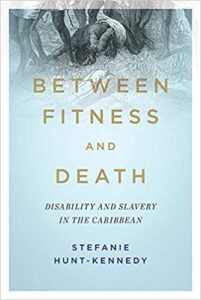 Stefanie Hunt-Kennedy, Between Fitness and Death: Disability and Slavery in the Caribbean (University of Illinois Press, 2020).
From the committee:
Between Fitness and Death is “an insightful and powerful study” that looks to early modern “West Indian slavery and the legal exploitation of black bodies to argue that “slavery disabled the human.” It is “methodologically rich,” “elegantly and thoroughly researched, argued, and written,” and expands scholarly capacities for attending to the interconnections between disability and race. “From accounts framing monstrosity as an element of deformity to fitness tests at British slave markets, this study unravels the ways in which early modern ideas of race were tied to perceptions of disability — a systematic connection that, at its most effective, reverberated through slave laws that allowed for violence against the Black body. “Compelling, fascinating. An important contribution.”
Honorable Mention
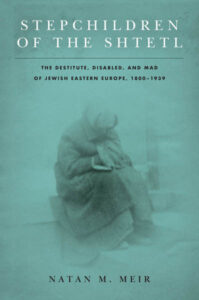 Natan Meir, Stepchildren of the Shtetl: The Destitute, Disabled, and Mad of Jewish Eastern Europe, 1800-1939(Stanford University Press, 2020).
From the committee:
“Beautifully written and compellingly argued,” Stepchildren of the Shtetl “explores the ways that marginalized people came to be understood within the framework of disability.” It is an “extraordinary study of the lived experiences of Jewish outcasts — the impoverished, disabled, and chronically ill — in Eastern Europe that deftly depicts the simultaneous perception of marginalized people as forerunners of modernity and as symbols of inadequacy.” Disabled Jewish people are “richly depicted and contextualized within religious and literary meanings and histories.” As such, Meir’s is a novel contribution to the field of disability history.”
2020 Outstanding Book Award
 Winner
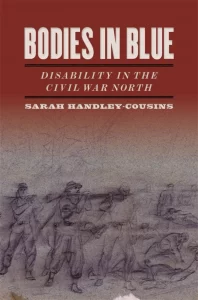
Sarah Handley-Cousins, Bodies in Blue: Disability in the Civil War North (Athens, GA: University of Georgia Press, 2019).
From the committee:
“Handley-Cousin’s book painstakingly analyzes… a wide variety of disabilities and impairments drawn from across the historical record of the Civil War and its aftermath.
“Bodies of Blue broadens and deepens the historical study of Americans with disabilities, thereby simultaneously expanding both American History and Disability History.”
“Well-written and carefully worded, Bodies in Blue demonstrates historical research and writing at its best.”
“Handley-Cousins’s work is written with sensitivity and detail that will interest the general public and academics alike.”
Honorable Mention
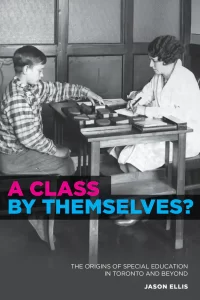 Jason Ellis, A Class by Themselves? The Origins of Special Education in Toronto and Beyond (Toronto: University of Toronto Press, 2019).
From the committee:
“a clearly written, well-organized overview of the history of auxiliary or special education for disabled children in Toronto, Canada, public schools, in the early twentieth century.”
“…thoughtfully and meticulously combines historical evidence…”
“… digs deep into institutional records left by educators and other professionals, skillfully coaxing details from pupil records that show how children and their parents often wielded their own agency…”
2019 Outstanding Article or Book Chapter Award
Winner
Maria Cristina Galmarini-Kabala, “Psychiatry, Violence, and the Soviet Project of Transformation: A Micro-History of the Perm Psycho-Neurological School-Sanatorium,” Slavic Review 77, no. 2 (Summer 2018): 307-332.
From the committee:
“The article is an example of micro-history at its best.”
“This microhistory of a child psychiatric institution makes a compelling argument that expands our knowledge of asylums and social control in the 20th century.”
“An insightful article within a specific period of time, within a specific institution, and under a range of specific regime approaches.”
“The conclusion that “violence existed—in the asylum and in Soviet society—in a continuum of cure and harm” is nuanced, sensitive to current disability scholarship, and extremely useful for scholars. Excellent article!”
Honorable Mention
Natalie Spagnuolo, “Mobilising Historical Knowledge: Locating the Disability Archive,” in Katie Ellis, Rosemarie Garland-Thompson, Mike Kent, and Rachel Robertson (eds.), Interdisciplinary Approaches to Disability: Looking Towards the Future (New York: Routledge, 2018), 153-163.
From the committee:
“… brings together disparate ideas to create a compelling, intelligent and thought-provoking whole.”
“… well written with a sophisticated analysis that will, I hope, start useful conversations in the field about the choices we make in our historical scholarship and the consequences of these choices for present-day disability activism.”
“… provides a nice historiography of broad themes and dilemmas in the field of disability history. Moreover, Spagnuolo raises important questions for the future of the field.”
2019 Outstanding Book Award (Co-Winners)
 Michael Rembis, Catherine Kudlick, and Kim E. Nielsen, eds., The Oxford Handbook of Disability History (New York: Oxford University Press, 2018).
From the committee:
“The capacious geographic, conceptual, and methodological reach of The Oxford Handbook of Disability History demonstrates just how far the field of disability history has come in the past two decades. The book also shows the manifold ways in which incorporating disability history promises to help scholars think anew about topics ranging from the histories of gay rights, work, and material culture to the nature of archives and historical documentation.”
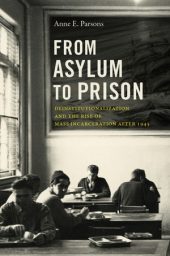 Anne E. Parsons, From Asylum to Prison: Deinstitutionalization and the Rise of Mass Incarceration after 1945 (Chapel Hill: The University of North Carolina Press, 2018).
From the committee:
Praise from the committee: “Lucidly written, Parsons’ powerful account places disability at the center of the burgeoning histories of mass incarceration and the prison industrial complex. From Asylum to Prison is especially compelling and insightful in the way it brings together race, prisons, the disability rights movement, and the related yet distinct deinstitutionalizations of people diagnosed with psychiatric disabilities and those labeled as having intellectual or developmental disabilities. Always attentive to historical complexities and the unintended consequences of policymaking, Parsons shows how we cannot fully understand the rise of mass incarceration without incorporating disability.”
2018 Outstanding Book Award
 Winner
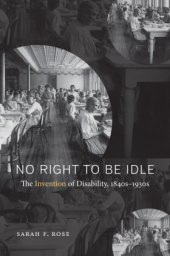
Sarah F. Rose, No Right to Be Idle: The Invention of Disability, 1840s-1930s (Chapel Hill: The University of North Carolina Press, 2017).
From the committee:
It “is a much-needed examination of how ideas about bodily difference and productivity became linked during the nineteenth century, and an exploration of the contradictions inherent in the suggestion that disability meant an inability to perform labor – most importantly… in the ways that figures of authority called for the institutionalization of apparently unproductive disabled people, but at the same time reinvigorated economically-strapped institutions by giving them unlimited access to the unpaid labor of these ‘unproductive’ inmates. In this way, such unpaid labor stopped being work and became, instead, therapy.”
No Right to Be Idle “ably tackles one of the big themes of disability — its connection to the labor force — and gives us a fundamental recalibration in how people with disabilities were labeled and pushed out of the labor force rather than having ex ante impairments that made them ‘unfit’ laborers. It shows the malleability of the disability label within historical context.”
Honorable Mention
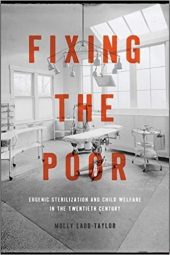
Molly Ladd-Taylor, Fixing the Poor: Eugenic Sterilization and Child Welfare in the Twentieth Century (Baltimore: Johns Hopkins University Press, 2017).
From the committee:
“This book clearly and powerfully argues for a reconceptualization of the history of American eugenics, one … focused on the practical needs and desires of impoverished, institutionalized people themselves.” It “ties eugenics to broader welfare state policies.” “Carefully researched and powerfully argued!”
2016 Outstanding Book Award
 Winner
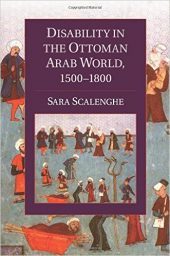
Sara Scalenghe, Disability in the Ottoman Arab World, 1500-1800 (New York: Cambridge University Press, 2014).
From the committee:
“Wonderful intervention on disability history: unique for its non-Western and pre-modern focus (as well as its points about “academic imperialism” in disability history)… Terrific examples and analysis of contingencies and ‘loopholes’ in Ottoman legal practices and categories.”
“[Disability in the Ottoman Arab World is an] excellent contribution to disability history that helps open up a new and much needed non-Western (and preindustrial) perspective in the field. Beautifully written in clear and accessible prose, Scalenghe’s book is also a very enjoyable read.”
“… accessible and informative. [Disability in the Ottoman Arab World] continues the important work of globalizing disability studies; it opens up new possibilities for comparative approaches; and it challenges the category of disability itself.”
Honorable Mention
 Paul K. Longmore, Telethons: Spectacle, Disability, and the Business of Charity (New York: Oxford University Press, 2016).
From the committee:
“[Telethons is a] superb study and a model of how to write disability history. Longmore’s book will surely be consulted by disability scholars and historians for years to come. Engagingly written and full of profound insights into a wide range of issues, it compellingly demonstrates the significance of disability to modern American culture.”
“… in-depth look at a common cultural phenomenon in America, impressive research and consideration of different factors (gender/social class, etc.), well-written and cited… [Longmore makes an] important intervention into the links between politics, the media, and private interests in constructing and presenting disability in modern U.S. discourse.”
2014 Outstanding Book Award
 Sebastian Barsch, Anne Klein, and Pieter Verstraete, eds., The Imperfect Historian: Disability Histories in Europe (Frankfurt am Main: Peter Lang, 2013).
From the committee:
“Drawing primarily, but not exclusively, on the provocative and far-reaching insights of the French philosopher Michel Foucault, The Imperfect Historian makes important methodological contributions to the field of disability history. Its temporal and geographic breadth and its deliberate engagement with theory and the methodologies of disability history are refreshing and provide a powerful framework for future historical investigation. Although the stated focus of this edited collection of historical essays is on Europe, various chapters explore disability history in Argentina, Brazil, and Spain and British Mandate Palestine and Israel, challenging the way we think about national boundaries. The seemingly disparate collection of essays that span Medieval and Early Modern European societies and late-twentieth century HIV/AIDS discourse are held together nicely by the volume’s strong focus on postmodern theorizations of identity, bio-politics, narrative, and governmentality. In clearly written, accessible prose, the contributors to this innovative volume challenge existing historiography and frameworks for understanding disability history.”
2012 Outstanding Book Award
 David M. Turner, Disability in Eighteenth-Century England: Imagining Physical Impairment (New York: Routledge, 2012).
The selection committee very much appreciated the book’s wide scope, deep engagement with disability history and theory, and the ways Turner used archival sources both to make an overarching argument and reveal individual stories from both elites and the lower classes. Disability in Eighteenth-Century England weaved the ideas of popular culture and individual representation together in nuanced and often humorous, but always respectful, ways. Turner’s witty and very readable prose combined with his thorough analysis of archival material make Disability in Eighteenth-Century England as a must-read for students and specialists.